Sell USDT in India
Learn how to sell USDT in India and receive INR through CoinYatra. Follow this simple step-by-step guide to sell USDT securely using CoinYatra's P2P marketplace and escrow protection.
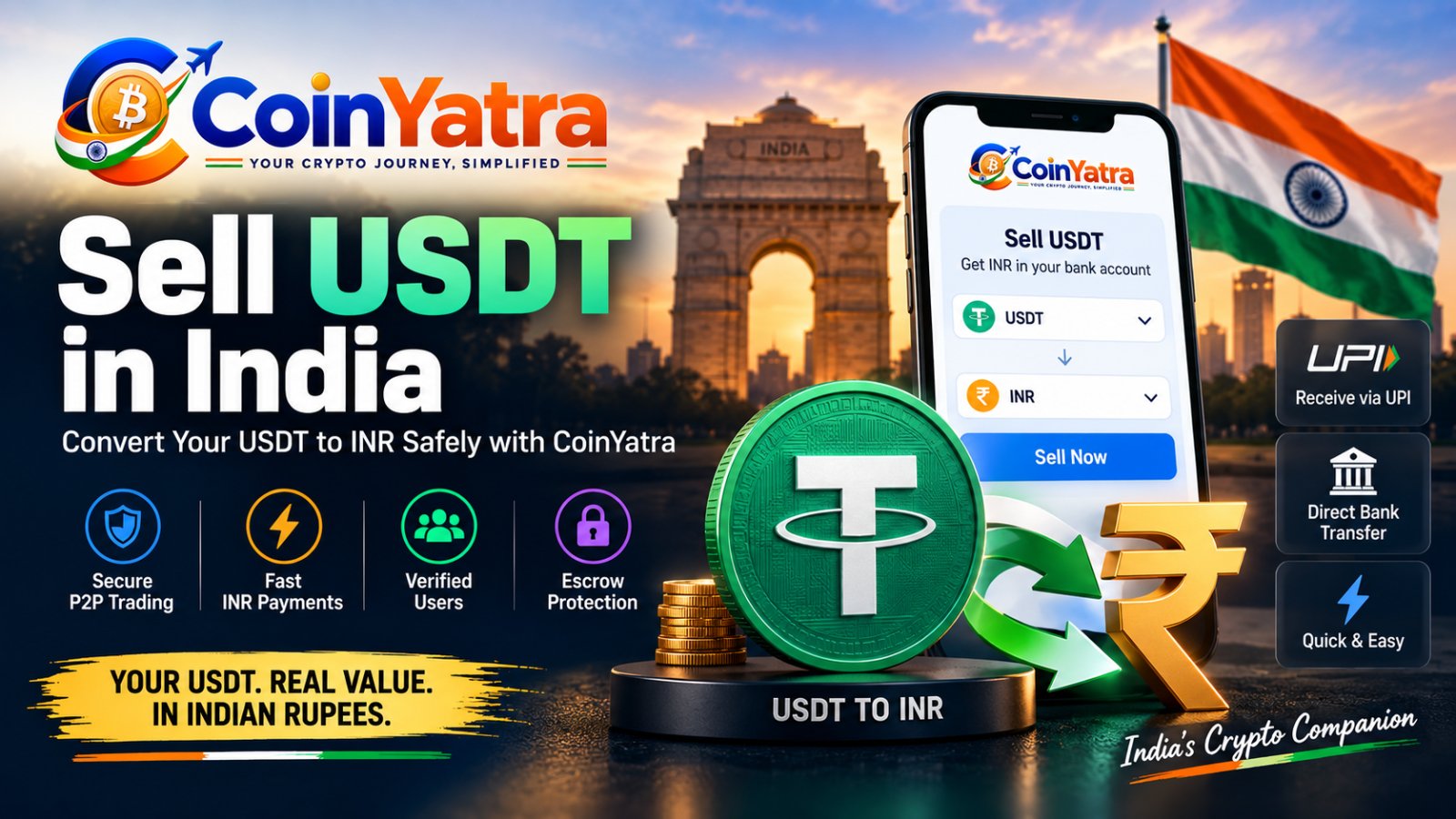
Sell USDT in India
USDT has become one of the most widely used stablecoins in the cryptocurrency market. For Indian crypto users, one common requirement is converting USDT into Indian Rupees (INR).
Whether you received USDT from another wallet, converted another cryptocurrency into USDT, or simply want to cash out your crypto holdings, selling USDT for INR requires choosing a suitable platform and payment method.
CoinYatra provides an INR-focused P2P marketplace where verified users can buy and sell supported cryptocurrencies, including USDT, using supported payment methods such as UPI and bank transfers. CoinYatra uses an escrow mechanism to hold the seller's crypto during the transaction until the payment is confirmed.
This guide explains how to sell USDT in India using CoinYatra, step by step.
What Is USDT?
USDT, also known as Tether USD, is a stablecoin designed to maintain a value close to one U.S. dollar.
Unlike cryptocurrencies such as Bitcoin, whose price can move significantly within a short period, USDT is designed to track the U.S. dollar.
USDT is commonly used by cryptocurrency traders to:
Move value between crypto platforms
Trade Bitcoin and other cryptocurrencies
Hold dollar-denominated crypto exposure
Send cryptocurrency between wallets
Convert crypto holdings before withdrawing into fiat currency
CoinYatra currently supports USDT on BEP20 and ERC-20 networks, so users should always verify which network their USDT is using before depositing or withdrawing.
How to Sell USDT in India Using CoinYatra
Selling USDT through CoinYatra's P2P marketplace can be completed in a few steps.
Step 1: Create Your CoinYatra Account
Visit CoinYatra.com and create your account using your email address or supported sign-in option.
For account security, CoinYatra recommends enabling two-factor authentication (2FA). KYC verification is required before using P2P trading and withdrawals.
Step 2: Complete KYC Verification
Before selling USDT through CoinYatra's P2P marketplace, complete the required identity verification.
KYC helps establish the identity of users participating in the marketplace and is part of the platform's compliance and security process.
Once your verification is complete, you can proceed with the P2P marketplace.
Step 3: Add Your INR Payment Method
Before creating or accepting a P2P USDT sale, make sure your payment method is ready.
Depending on the available options, this can include:
UPI
Bank account
Use a payment account held in your own verified name.
This is important because payment-name mismatches can create delays or disputes during a P2P transaction.
Step 4: Go to P2P Trading
Open the P2P marketplace on CoinYatra.
Select:
Sell → USDT → INR
You can then review available buyers and their advertised prices and limits.
CoinYatra's P2P marketplace allows users to trade supported cryptocurrencies directly with other users in INR while the crypto being sold is held in escrow.
Step 5: Compare Available Offers
Don't automatically choose the first offer you see.
Compare the available advertisements based on:
INR price per USDT
Minimum and maximum order limits
Payment method
Payment window
Trader information
Available USDT amount
P2P prices can differ because individual traders create their own offers.
If you are selling a larger amount of USDT, checking multiple offers can help you understand the available market price.
Step 6: Enter the Amount of USDT You Want to Sell
Enter the amount of USDT you want to sell.
CoinYatra will show the relevant transaction details before you confirm the order, including the applicable seller fee. CoinYatra's current guide states that the seller fee is 0.3% on the crypto side, with the fee displayed before confirmation.
Review the:
USDT amount
INR amount
Exchange rate
Payment method
Fees
Order limits
Then confirm the transaction.
Step 7: CoinYatra Holds Your USDT in Escrow
Once the P2P sale is confirmed, your USDT is placed into escrow.
This is an important part of the process.
The USDT remains locked while the buyer sends the INR payment. This helps prevent the seller from losing the cryptocurrency before payment has been received.
CoinYatra states that its P2P marketplace uses escrow protection and dispute resolution for transactions.
Step 8: Wait for the INR Payment
The buyer sends the agreed INR amount using the payment method specified in the order.
This is where sellers need to be especially careful.
Do not release the USDT simply because the buyer sends a payment screenshot.
Instead, open your own banking or UPI application and verify that:
The payment has actually arrived.
The amount is correct.
The transaction is reflected in your account.
The payment details match the P2P order.
CoinYatra specifically advises sellers to verify the actual bank credit rather than relying on screenshots.
Step 9: Release the USDT
Once you have independently confirmed that the correct INR payment has been credited to your account, return to the P2P order and release the USDT from escrow.
The transaction can then be completed.
Never release USDT based only on:
A WhatsApp message
An SMS screenshot
A payment screenshot
A buyer's claim that payment has been sent
A fake bank notification
Always verify the money in your own bank or UPI account first.
How Long Does It Take to Sell USDT?
The time required can depend on the buyer, payment method and transaction.
CoinYatra's P2P marketplace uses defined payment windows for orders. Its current dashboard guide states that P2P orders use a 15-minute payment window.
Once the buyer sends the payment and you verify the funds, the seller can release the USDT.
Can You Sell USDT Directly for INR?
Yes.
The CoinYatra P2P marketplace is designed to allow users to buy and sell supported crypto assets directly against INR.
This means you don't necessarily have to first convert your USDT into another cryptocurrency such as Bitcoin or Ethereum.
The basic process is:
USDT → P2P Sell → INR → Your UPI/Bank Account
That makes P2P particularly relevant for Indian users who want to convert cryptocurrency into rupees.
What If You Have Bitcoin or Ethereum Instead?
You don't necessarily need to sell BTC or ETH directly for INR.
A common workflow is:
Bitcoin / Ethereum → USDT → Sell USDT for INR
CoinYatra supports spot trading as well as P2P trading, allowing users to separate the crypto-to-crypto conversion from the INR settlement.
For example:
BTC → USDT
Then:
USDT → INR
This can make the process easier to understand because the spot market handles the crypto conversion while P2P handles the INR settlement.
USDT BEP20 vs ERC-20: What Should You Choose?
This is an important point for anyone transferring USDT.
USDT can exist on different blockchain networks.
CoinYatra currently supports USDT BEP20 and USDT ERC-20.
Before sending USDT to CoinYatra—or withdrawing it to another wallet—always make sure the selected network matches the destination.
For example, sending USDT through an unsupported network to an address expecting another network can result in funds becoming difficult or impossible to recover.
Always check the network before confirming a blockchain transaction.
What Are the Fees for Selling USDT?
The applicable fee should always be checked on the CoinYatra order screen before confirming the transaction.
CoinYatra's current P2P selling guide states that the seller fee is 0.3% on the crypto side, and the fee is displayed before the seller confirms the order.
Because platform fees and policies can change, users should rely on the fee displayed in the live order rather than an old article or screenshot.
Is Selling USDT in India Legal?
Indian cryptocurrency regulation involves several different areas, including taxation and anti-money-laundering requirements.
The Indian government brought qualifying VDA service providers within the AML/CFT framework in 2023. FIU-IND says VDA service providers operating in India—whether offshore or onshore—and carrying out covered activities are required to register with FIU-IND and comply with applicable PMLA obligations.
The latest regulatory environment means Indian crypto users should pay attention to the platform they use and maintain appropriate transaction records.
What About Crypto Tax in India?
Crypto transactions can have tax implications in India.
The Income Tax Department's current VDA guidance states that income arising from the transfer of VDAs is generally taxed at 30%, subject to the applicable rules, with deductions generally limited to the cost of acquisition. The guidance also describes the 1% TDS mechanism under Section 194S, subject to its conditions and thresholds.
However, the tax treatment of an individual's transaction can depend on the circumstances.
Therefore, users should:
Keep records of USDT purchases
Record USDT sales
Keep transaction IDs
Save exchange statements
Record INR receipts
Maintain relevant bank statements
Keep track of acquisition costs
For tax filing, consider consulting a qualified Indian tax professional rather than relying solely on a general online article.
Safety Tips When Selling USDT in India
Selling USDT through P2P can be straightforward, but users should still follow basic security practices.
Never release USDT before receiving payment
The most important rule for a seller is simple:
Check your bank account first.
Use your own payment account
Use a UPI ID or bank account in your verified name whenever required by the transaction.
Don't move the conversation unnecessarily outside the platform
Keep important transaction communication within the CoinYatra P2P order where possible.
Don't trust screenshots
A screenshot is not proof that money has reached your account.
Check the exact amount
If the order says ₹50,000, verify that ₹50,000 has actually arrived.
Check the payment sender
Make sure the payment details are consistent with the P2P transaction and platform requirements.
Keep transaction records
Save your order details and transaction history for your own records.
Sell USDT in India With CoinYatra
For Indian users looking for an INR-focused way to sell USDT, CoinYatra provides a P2P marketplace with escrow protection, verified users, INR payment methods and transaction records.
The basic process is simple:
1. Create a CoinYatra account
↓
2. Complete KYC
↓
3. Add your UPI or bank payment method
↓
4. Select P2P → Sell → USDT
↓
5. Choose an available INR offer
↓
6. Confirm the USDT sale
↓
7. Wait for the INR payment
↓
8. Verify the money in your bank/UPI account
↓
9. Release the USDT
That's it.
Start Selling USDT on CoinYatra
Frequently Asked Questions
Can I sell USDT for INR in India?
Yes. CoinYatra's P2P marketplace supports selling USDT against INR through supported payment methods.
How do I sell USDT on CoinYatra?
Complete KYC, open the P2P marketplace, select Sell → USDT, choose an available INR offer, confirm the order, wait for the buyer's payment, verify the INR in your bank account and then release the USDT from escrow.
Can I sell USDT through UPI?
CoinYatra supports UPI or bank payment methods for its INR-focused P2P marketplace, subject to the payment methods available on the order.
Is KYC required to sell USDT on CoinYatra?
Yes. CoinYatra states that KYC is required for P2P trading and withdrawals.
What USDT networks does CoinYatra support?
CoinYatra currently supports USDT BEP20 and ERC-20. Always select the correct network when depositing or withdrawing.
How much USDT can I sell?
CoinYatra's current dashboard guide states that P2P orders are available between ₹500 and ₹5,00,000, subject to the available offers and platform rules.
What should I do if the buyer says they paid but I haven't received the money?
Do not release your USDT. Check your own bank or UPI account. If the payment has not arrived or something does not match, use the platform's dispute process rather than releasing the crypto.
Final Thoughts
Selling USDT in India doesn't have to be complicated.
The important things are choosing an appropriate platform, completing KYC, checking the INR price and payment method, understanding the applicable fee, and—most importantly—verifying the payment before releasing your USDT.
With CoinYatra's INR-focused P2P marketplace and escrow-based transaction flow, Indian users can sell USDT for INR through a straightforward process.
If you're ready to sell, you can visit:
CoinYatra.com — Sell USDT in India
Disclaimer: This article is for educational and informational purposes only and is not financial, investment, tax or legal advice. Cryptocurrency assets are volatile and involve risks, and regulatory/tax requirements can change. Users should verify the latest applicable requirements and consult qualified professionals where appropriate.