Crypto KYC Explained: What It Is and Why Exchanges Require It
Learn what crypto KYC means, why exchanges verify users, what documents may be required, how KYC works on CoinYatra, and how to protect your personal information.
What Is Crypto KYC?
KYC stands for Know Your Customer. It is the process through which a financial or crypto service provider verifies information about a customer before allowing certain services or transactions.
For a cryptocurrency exchange, KYC can involve collecting and verifying information such as your name, date of birth, identity document and other details needed to establish who you are.
KYC is an important part of the compliance and security processes used by crypto service providers. In India, Virtual Digital Asset (VDA) service providers covered by the applicable anti-money-laundering framework have customer due-diligence and related compliance obligations. FIU-IND's guidelines describe KYC, customer due diligence, ongoing due diligence, record keeping and transaction monitoring as parts of this framework.
For users, this means that completing verification may be required before accessing certain exchange or P2P services.
Why Do Crypto Exchanges Require KYC?
KYC is not simply a formality. It helps an exchange establish that an account belongs to a real customer and provides information needed for compliance and account-security processes.
Some of the main reasons exchanges use KYC include:
Identity verification
KYC helps connect an exchange account with a verified individual. This can make it harder for someone to create or operate an account using another person's identity.
Fraud prevention
Identity verification can help exchanges investigate suspicious activity and reduce certain types of account misuse, impersonation and fraud.
Anti-money-laundering compliance
Under India's applicable AML framework, VDA service providers that fall within the reporting-entity regime have customer due-diligence, record-keeping, internal-control and transaction-monitoring obligations. FIU-IND states that registration is a prerequisite for reporting entities providing covered VDA services.
P2P trading protection
KYC can also be particularly relevant for peer-to-peer trading. When users buy or sell crypto directly with other users, having verified accounts provides an additional layer of account identification and helps the platform manage disputes and suspicious activity.
Learn more about how P2P trading works in our Crypto P2P guide.
What Information Is Usually Required for KYC?
The exact requirements can vary depending on the service provider, account type and applicable rules.
A crypto exchange may ask for information such as:
Full name
Date of birth
Residential information
Government-issued identity information
Identity documents
A selfie or other verification step
Additional information where required for compliance
Not every exchange uses exactly the same verification process.
You should always submit documents only through the exchange's official verification process. Avoid sending identity documents through unofficial social-media accounts, messaging apps or unknown links.
How Crypto KYC Works on CoinYatra
On CoinYatra, the KYC process is designed to verify your identity before you access services that require verification.
The general process is straightforward:
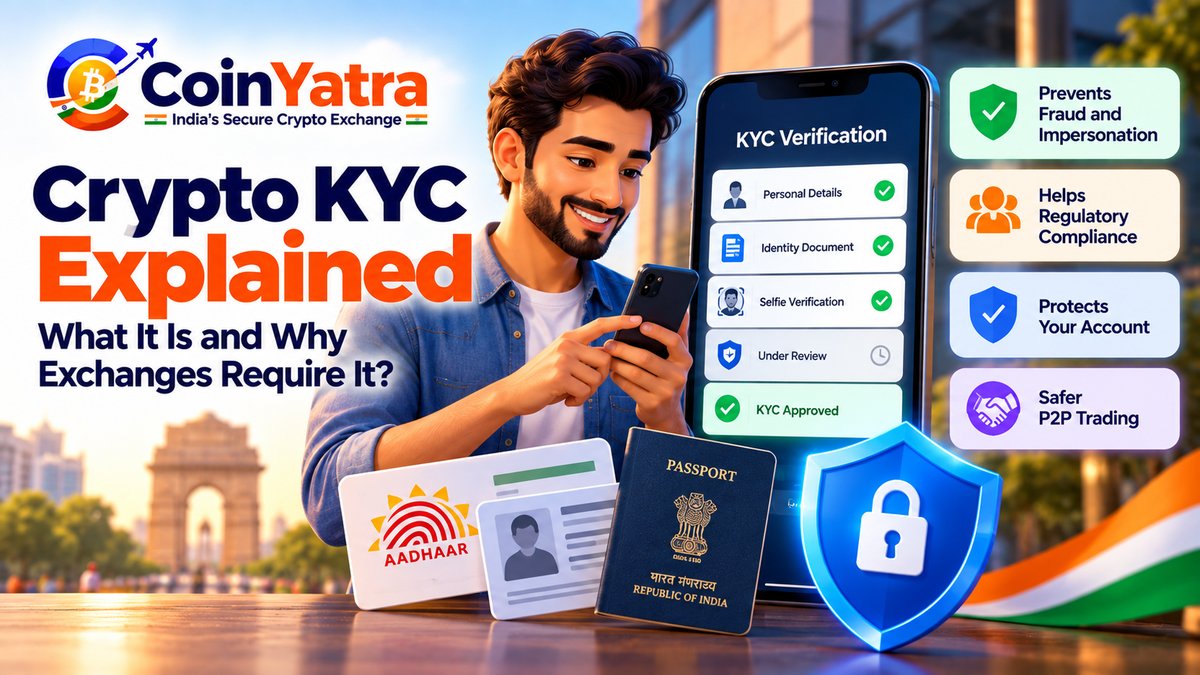
Create your account → Submit verification details → Upload the required documents → Wait for review → Receive verification approval
Once your verification has been approved, you can access services subject to your account's applicable limits and requirements.
For CoinYatra P2P trading, identity verification must be approved before you can trade on the P2P marketplace.
This helps ensure that participants in P2P transactions have completed the platform's required verification process.
What Happens After You Submit KYC?
Submitting your information does not necessarily mean that verification is immediately complete.
The information and documents submitted during KYC may need to be reviewed before an account is approved.
Depending on the verification process, you may experience one of several outcomes:
Approved: Your submitted information has passed the required checks.
Additional information required: You may need to provide another document or correct information.
Verification pending: Your submission is still being reviewed.
Rejected: The submitted information or documents did not satisfy the applicable verification requirements.
If your verification is unsuccessful, check the reason provided by the platform and follow the instructions for submitting the required information again.
Why Can KYC Take Time?
KYC verification may not always be instant.
Reviews can take longer when:
Documents are unclear or difficult to read.
The information entered does not match the submitted document.
A document has expired.
Additional verification is required.
There is a higher volume of verification requests.
Manual review is required.
To reduce unnecessary delays, make sure the information you provide is accurate and that uploaded documents are clear and valid.
Does KYC Mean the Exchange Knows Your Password?
No.
KYC information and account authentication credentials serve different purposes.
A legitimate exchange should not need your password or two-factor authentication code to verify your identity.
Never share your password, OTP, private key, seed phrase or 2FA code with another person claiming to be an exchange employee.
If someone contacts you asking for these details to "complete KYC," treat the request as suspicious.
For more security guidance, visit the CoinYatra Security page.
How to Protect Your KYC Information
Your identity documents contain sensitive personal information, so protecting them is important.
Follow these basic precautions:
Use the official website or app
Complete KYC only through the official CoinYatra website or application. Check the website address carefully before uploading documents.
Do not send documents to random people
Customer-support conversations should not require you to send identity documents to an unknown personal account on Telegram, WhatsApp, Instagram or another social platform.
Never share passwords or 2FA codes
KYC does not require you to disclose your account password, private key, recovery phrase or 2FA authentication code.
Check links carefully
Scammers can create websites that look similar to legitimate exchanges. Before entering your personal information, verify that you are using the official CoinYatra website or app.
Keep your account secure
Use a strong, unique password and enable available security features such as two-factor authentication.
KYC and Privacy: What Should Users Understand?
KYC requires users to provide personal information, but users should also understand how their information is handled.
Before submitting sensitive documents, review the platform's privacy policy and understand what information is collected, why it is collected and how it is handled.
KYC information should be provided only when it is requested through the platform's legitimate verification process.
It is also a good practice to avoid keeping unnecessary copies of identity documents in unsecured locations such as public cloud folders, shared computers or unprotected messaging chats.
Is KYC the Same as Crypto Tax Verification?
No.
KYC and taxation are different things.
KYC is primarily about identifying and verifying a customer and meeting applicable compliance requirements.
Tax reporting and tax obligations concern the treatment of taxable income and transactions under applicable tax laws.
Completing KYC does not by itself determine whether a particular crypto transaction is taxable.
If you have questions about your individual tax position, consult a qualified tax professional.
KYC and Crypto Withdrawals
Depending on the platform and applicable requirements, verification may also affect which services or transaction limits are available to an account.
For example, an exchange may apply different withdrawal limits, trading limits or account permissions depending on the user's verification status.
Before making a transaction, check the current requirements and limits displayed by the platform.
KYC and P2P Crypto Trading
KYC becomes particularly relevant when using a P2P marketplace.
In a P2P transaction, one user may buy cryptocurrency from another user using INR. The platform can use account verification and escrow mechanisms to provide structure around the transaction.
On CoinYatra, approved identity verification is required before users can trade on P2P.
The basic process works like this:
Buyer selects an offer → Seller's crypto is placed in escrow → Buyer sends INR → Seller confirms payment → Crypto is released
KYC does not eliminate every risk associated with P2P trading, so users should still follow transaction-safety practices.
Never release crypto based solely on a screenshot or payment message. Confirm that the money has actually reached your account before completing a sale.
Common Crypto KYC Mistakes to Avoid
Beginners often make simple mistakes during verification.
Avoid:
Entering a name that does not match your identity document.
Uploading blurry or cropped documents.
Using an expired document.
Uploading documents through unofficial links.
Sharing OTPs or 2FA codes with someone claiming to provide KYC support.
Creating multiple accounts to bypass verification requirements.
Ignoring requests for additional verification.
Posting identity documents publicly or in social-media groups.
Taking a few minutes to check your information before submitting it can prevent unnecessary delays.
Why KYC Is Important for a Crypto Exchange
Crypto transactions can involve significant amounts of value and can take place across different wallets, blockchains and jurisdictions.
For exchanges operating within applicable regulatory frameworks, KYC and customer due diligence form part of broader compliance systems designed to identify customers, maintain records and monitor transactions.
FIU-IND's published VDA guidelines specifically describe effective KYC, customer due diligence, enhanced due diligence where appropriate, ongoing due diligence, transaction monitoring and record keeping as components of the compliance framework for covered reporting entities.
For users, the practical takeaway is simple: expect identity verification when using regulated or compliance-focused crypto services, and treat your KYC information as sensitive personal data.
Final Thoughts
Crypto KYC is the process of verifying who you are before accessing certain cryptocurrency services.
For beginners, the process can seem like an extra step, but understanding why it exists makes it easier to use an exchange safely and responsibly.
When completing KYC:
Use the official exchange website or app.
Provide accurate information.
Upload clear and valid documents.
Never share passwords, private keys, seed phrases or 2FA codes.
Check the platform's privacy and security information.
Follow the exchange's current verification and transaction requirements.
If you are using CoinYatra, complete verification through the official verification process before using services that require KYC approval.
This article is for general educational and informational purposes only and does not constitute legal, financial or tax advice. Regulatory requirements and platform procedures can change. Refer to current official sources and professional advisers for advice about your individual circumstances.
Sources: FIU-IND, AML & CFT Guidelines for Reporting Entities Providing Services Related to Virtual Digital Assets; FIU-IND registration guidance for VDA service providers.