USDT to INR: What Moves the Rate?
Why the rupee price of USDT differs from ₹ per US dollar, and what pushes it up or down.
USDT to INR: What Moves the Rate?
USDT is a stablecoin designed to track the value of the US dollar. However, the price you see when converting USDT to INR is not always exactly the same as the official USD/INR exchange rate.
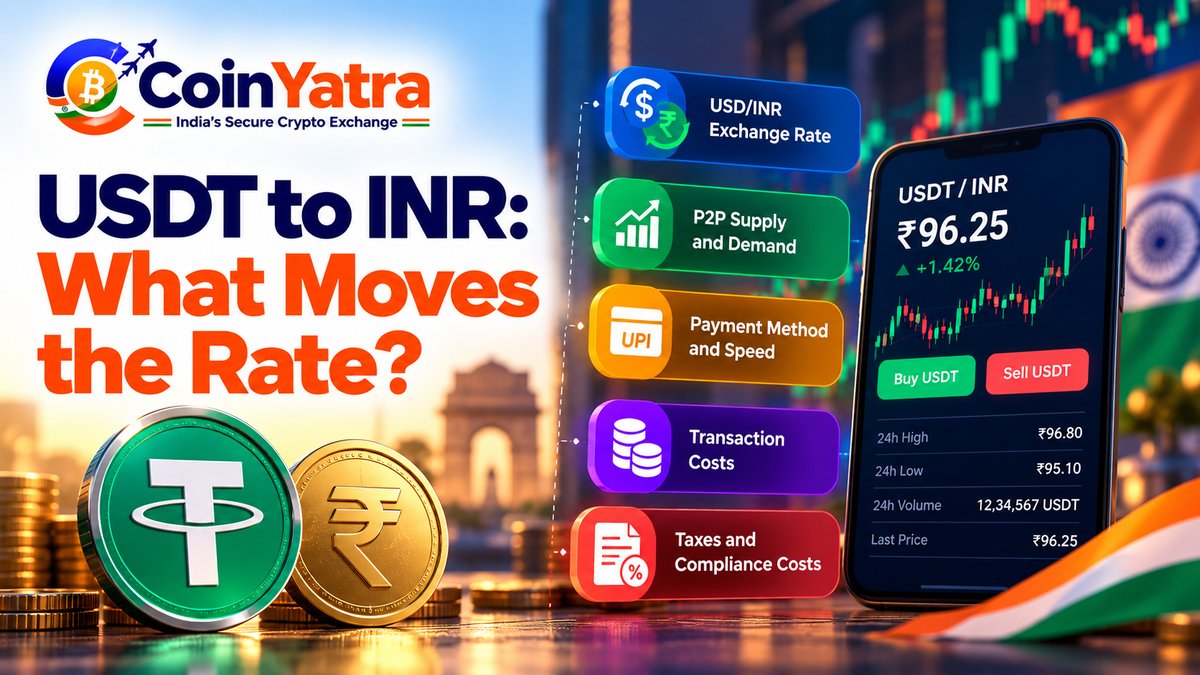
For users in India, the price of USDT in rupees can be influenced by several factors, including the USD/INR exchange rate, P2P supply and demand, payment methods, transaction costs, and other market conditions.
Understanding these factors can help you make better sense of the USDT to INR rate you see when buying or selling USDT.
You can also check CoinYatra's live USDT to INR price page to see the current market reference before starting a transaction.
What Does USDT to INR Mean?
USDT to INR represents how many Indian rupees are required to buy or how many rupees you may receive for selling one USDT.
For example, if the market price is ₹96 per USDT, then:
1 USDT ≈ ₹96
10 USDT ≈ ₹960
50 USDT ≈ ₹4,800
100 USDT ≈ ₹9,600
500 USDT ≈ ₹48,000
1,000 USDT ≈ ₹96,000
These are only examples. The actual price can change, and the final transaction amount may also depend on the platform, payment method, fees, and the specific offer available.
1. The USD/INR Exchange Rate
One of the most important factors behind the USDT to INR price is the value of the Indian rupee against the US dollar.
Because USDT is designed to track the US dollar, changes in the USD/INR exchange rate can influence its INR value.
For example, if the rupee becomes weaker against the US dollar, the rupee value of a dollar-denominated asset such as USDT can generally increase.
Likewise, if the rupee strengthens against the US dollar, the INR value of USDT may move lower, all else being equal.
This is why the USDT INR price can change even when USDT itself remains close to its intended dollar value.
2. P2P Supply and Demand
Supply and demand can have a significant effect on the price users see on a P2P crypto marketplace.
In a P2P transaction, buyers and sellers can offer their own prices according to the marketplace's rules.
Suppose many users want to purchase USDT while relatively few sellers are offering USDT. Sellers may list their USDT at higher prices.
On the other hand, if there are more sellers than buyers, competitive offers may bring prices closer to the prevailing reference rate.
This means that the USDT price shown on a P2P marketplace may differ from a simple USD/INR calculation.
The difference does not necessarily mean that the underlying USDT has stopped tracking the dollar. It can simply reflect the supply and demand conditions of the particular marketplace.
3. Payment Method Can Affect the Price
The payment method used in a P2P transaction can also influence the price of an offer.
For example, sellers may provide different prices depending on whether an offer supports:
UPI
Bank transfer
Other supported payment methods
A payment method that is faster or more convenient for a particular buyer may be associated with a different offer price.
Therefore, when comparing USDT to INR prices, it is useful to compare offers using the same payment method rather than looking only at the headline price.
4. Transaction and Platform Costs
The price of USDT is not necessarily the only cost involved in a transaction.
Depending on the platform and transaction type, users may encounter costs such as:
Trading or transaction fees
P2P-related costs
Withdrawal fees
Blockchain network fees
Costs associated with moving USDT between wallets
Sellers and traders may consider these costs when setting their prices.
For this reason, two USDT offers can have slightly different prices even when they are available at approximately the same time.
When comparing offers, look at the total amount you will pay or receive, rather than comparing only the USDT unit price.
5. Blockchain Network Fees
USDT can exist on different blockchain networks. Depending on the network used for a deposit or withdrawal, the transaction may involve a network fee.
Network fees are separate from the market value of USDT.
For example, if you purchase USDT at a particular INR price and later withdraw it to an external wallet, the amount received may be affected by the applicable withdrawal or network-related charges.
Always check the supported blockchain network before sending or withdrawing USDT.
Sending an asset through an unsupported or incorrect network can result in funds not being received correctly.
6. Market Conditions and Trading Activity
Crypto markets operate continuously, and prices can change as buyers and sellers place orders.
Changes in trading activity can therefore affect the prices available at a particular moment.
During periods of increased market activity, the difference between available buy and sell offers can change quickly.
This is particularly relevant when comparing a general USDT price with a specific P2P offer.
A price shown at one moment may not remain available later.
7. Why the USDT Price May Differ From USD/INR
A common question is:
"If USDT tracks the US dollar, why isn't 1 USDT exactly equal to the USD/INR exchange rate?"
The answer is that the two prices represent different things.
The USD/INR exchange rate represents the value of one US dollar relative to the Indian rupee.
The USDT/INR price represents the price at which USDT is available in the relevant crypto market or transaction.
The USDT price can therefore be influenced by:
USD/INR rate + crypto market conditions + supply and demand + payment method + fees + liquidity
This is why a P2P USDT price may be somewhat higher or lower than a simple USD/INR conversion.
Market Price vs Transaction Price
It is also important to understand the difference between a reference price and the price of an actual transaction.
A reference price gives you an indication of the current market value.
The actual transaction price depends on the specific market, order, P2P advertisement, available liquidity, payment method, fees, and the amount being traded.
For example, a user may see a general USDT reference price of ₹96 but find that available P2P offers are listed at slightly different prices.
This does not necessarily indicate an error. The two prices can reflect different market conditions and transaction costs.
How to Check the USDT to INR Rate
Before buying or selling USDT, consider checking:
Current reference price:
Look at the current USDT/INR market reference.
Available offers:
If using P2P, compare the available offers rather than relying on a single listing.
Payment method:
Check whether the offer supports your preferred payment method.
Fees:
Review the applicable transaction, withdrawal, or network fees.
Amount received:
Check the final amount you will receive after applicable costs.
Blockchain network:
If transferring USDT to or from an external wallet, confirm that the selected network is supported on both sides.
CoinYatra users can check the live USDT to INR price before starting a transaction.
Example: Why Two USDT Offers Can Have Different Prices
Imagine two sellers are offering USDT at the same time.
Seller A offers:
1 USDT = ₹96
Seller B offers:
1 USDT = ₹97
At first glance, the second offer appears more expensive.
However, the offers may have different payment methods, available quantities, seller terms, or other transaction conditions.
This is why users should compare the complete transaction rather than looking only at the displayed USDT price.
For a larger transaction, even a small difference in the per-USDT price can affect the total INR amount.
What Should You Check Before Converting USDT to INR?
Before completing a conversion or P2P transaction, check the following:
Check the Current Rate
Start by checking the current USDT to INR price so you have a reference point.
Compare Available Offers
If you are using a P2P marketplace, compare multiple available offers where appropriate.
Check the Payment Method
Make sure the payment method shown in the offer matches the method you intend to use.
Review Fees
Look at applicable platform, withdrawal, and network fees before confirming.
Check the Final Amount
Don't rely only on the advertised unit price. Review the final INR amount you will pay or receive.
Verify Transaction Details
Before confirming a transaction, carefully review the amount, payment details, wallet address, and blockchain network where applicable.
Consider Taxes and Compliance
Crypto transactions in India may have tax and compliance implications. Tax treatment can depend on the nature of the transaction and the user's circumstances. For personal tax questions, consider consulting a qualified tax professional.
USDT to INR: Key Takeaway
The USDT to INR rate is influenced by more than the USD/INR exchange rate.
The main factors include the value of the Indian rupee against the US dollar, P2P supply and demand, payment methods, liquidity, transaction costs, blockchain network fees, and overall market conditions.
This means the price shown on a crypto marketplace can differ from a simple USD-to-INR conversion.
Before buying or selling USDT, compare the available price, review the applicable fees, check the payment method, and confirm the final transaction amount.
You can check CoinYatra's live USDT to INR price page to see the current reference price.
If you're looking to purchase USDT in India, you can also learn more through Buy USDT in India.
Crypto prices can change quickly. This article is provided for educational and informational purposes only and is not investment, financial, tax, or legal advice. Please consider your own circumstances and consult a qualified professional where appropriate.