USDT to INR: How the Conversion Rate Works in India
Learn how the USDT to INR rate works in India, why it changes, and how market prices, P2P offers, USD/INR rates and transaction fees can affect your final conversion value.
USDT to INR: How the Conversion Rate Works in India
If you hold USDT and want to understand how much it is worth in Indian Rupees, one of the first questions you may have is:
How is the USDT to INR rate calculated?
USDT, or Tether, is designed to track the value of the U.S. dollar. Because of that, its value in Indian Rupees is influenced heavily by the USD/INR exchange rate. However, the price you actually receive when buying or selling USDT can be different from a simple USD-to-INR conversion.
Market conditions, liquidity, P2P demand, trading prices, fees and the specific transaction method can all affect the final amount.
In this guide, we'll explain how the USDT to INR conversion rate works in India, why it changes, the difference between a reference market price and an actual transaction price, and what you should check before converting USDT into INR.
What Is USDT?
USDT (Tether) is a dollar-pegged stablecoin designed to track the value of the U.S. dollar. Tether describes USD₮ as a token intended to mirror the value of the U.S. dollar.
In simple terms:
1 USDT ≈ 1 USD
But that does not mean:
1 USDT = a fixed amount of INR
The Indian Rupee value changes because the INR value of one U.S. dollar changes.
For example, if:
1 USD = ₹96
then a simple reference calculation would put:
1 USDT ≈ ₹96
But the actual USDT/INR price available in a market or P2P transaction may be somewhat higher or lower.
That's where the difference between a reference rate and an actual transaction rate becomes important.
What Determines the USDT to INR Rate?
There isn't just one factor that determines the price.
A useful way to understand it is:
USDT/INR ≈ USDT/USD × USD/INR
Since USDT generally trades close to the U.S. dollar, the USD/INR exchange rate is an important component of its INR reference value.
However, the actual trading price can also be affected by supply and demand.
The main factors include:
USD/INR exchange rate
USDT market price
Supply and demand
P2P marketplace liquidity
Buyer and seller pricing
Market volatility
Transaction fees
Payment method
Order size
CoinYatra's USDT/INR page specifically notes that USDT's rupee value moves with the USD/INR rate, while P2P advertisements can have their own prices.
Why Does USDT to INR Change?
You may notice that the USDT-to-INR rate isn't always exactly the same.
That's normal.
1. USD/INR Moves
The first major factor is the exchange rate between the U.S. dollar and Indian Rupee.
If the dollar becomes more expensive in INR terms, the INR value of USDT can also rise.
For example:
USD/INR = ₹90
A reference USDT value may be around:
1 USDT ≈ ₹90
If USD/INR later moves to:
₹95
then the reference value may move closer to:
1 USDT ≈ ₹95
This is a simplified example, but it illustrates the relationship.
2. USDT Can Trade Slightly Above or Below $1
Although USDT is designed to track the U.S. dollar, its market trading price can move slightly above or below $1 on trading venues.
Tether itself explains that exchange prices can move away from $1 during periods of changing liquidity and demand.
So the calculation isn't necessarily:
USDT = exactly $1 × USD/INR
The market price of USDT can introduce a small difference.
3. P2P Supply and Demand
P2P trading works differently from a simple currency conversion.
On a P2P marketplace, one user may want to sell USDT, while another user wants to buy USDT using INR.
The seller can offer a particular INR price, and buyers can choose among available offers.
That means the P2P price can differ from a reference market price.
CoinYatra's current USDT/INR page explains that P2P ads carry their own prices based on the trader and that the actual P2P or settlement rate is shown before an order is confirmed.
Reference Price vs Transaction Price
This is one of the most important concepts to understand.
Suppose a website shows:
1 USDT = ₹96
That doesn't necessarily mean you will receive exactly ₹96 for every USDT when you sell.
The displayed number could be a reference or market price.
Your actual transaction may have a different price.
Reference Price
A reference price helps you understand the approximate market value of USDT in INR.
Transaction Price
The transaction price is the rate actually used for your specific purchase or sale.
It can depend on:
The P2P offer
Available liquidity
Market conditions
Order size
Fees
Payment method
The platform's pricing mechanism
This distinction is particularly important when comparing a USDT/INR price page with an actual P2P order.
Check the Live USDT to INR Price
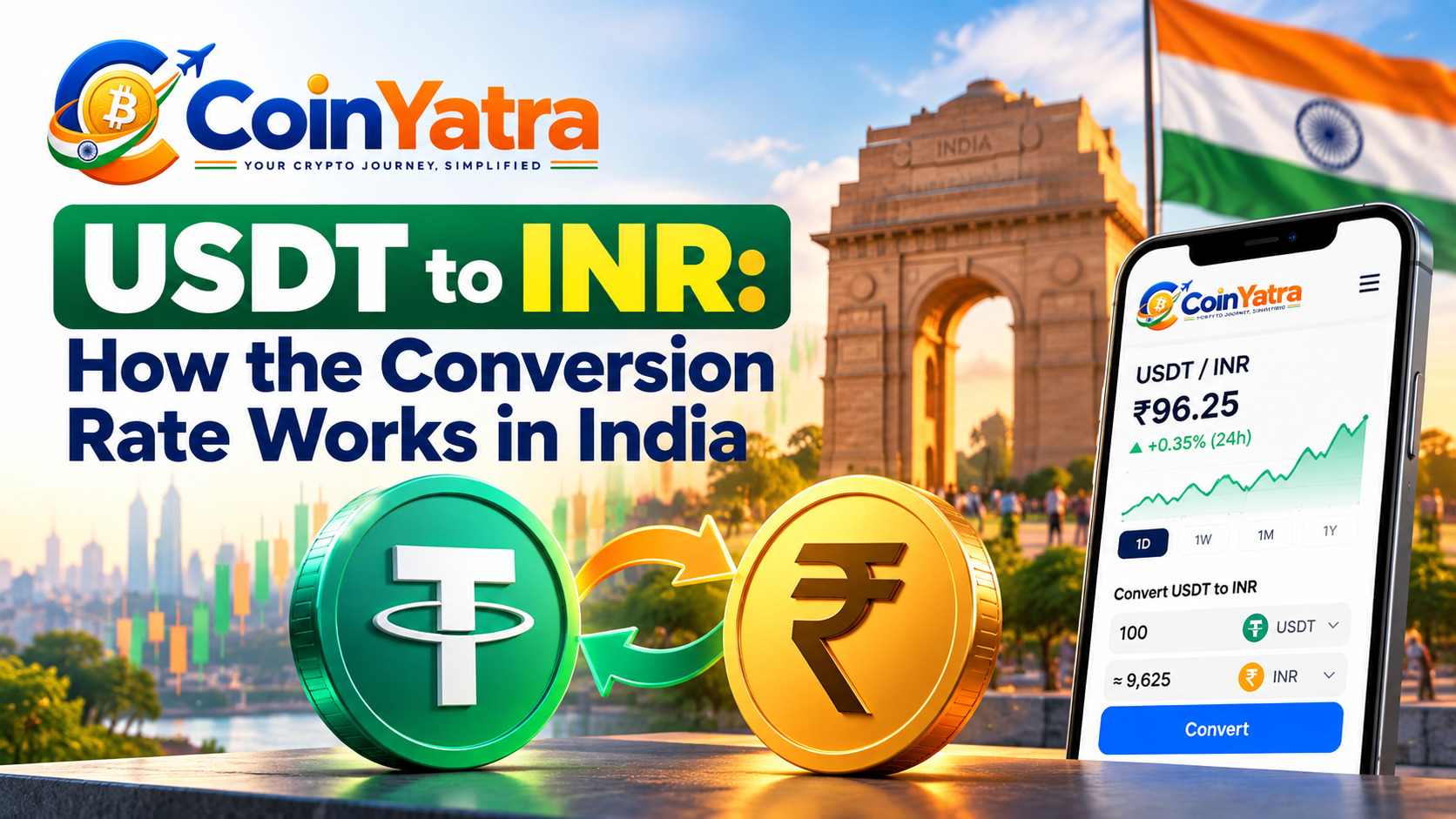
If you're looking for the current reference value of USDT in Indian Rupees, CoinYatra provides a dedicated USDT-to-INR price page with a live reference price, USD/INR reference rate and calculator.
Check the live USDT to INR price on CoinYatra
The page also lets you calculate the approximate INR value of different USDT amounts.
For example:
1 USDT → INR
10 USDT → INR
100 USDT → INR
1,000 USDT → INR
The displayed calculator is indicative, while the actual P2P or settlement rate is shown before you confirm an order.
How to Calculate USDT to INR
The basic calculation is simple.
Formula
USDT amount × USDT/INR rate = INR value
For example, suppose the reference rate is:
1 USDT = ₹96
If you have:
100 USDT
then:
100 × ₹96 = ₹9,600
So the reference value would be approximately:
₹9,600
However, the actual amount you receive can differ depending on the transaction rate and applicable fees.
USDT to INR Examples
Let's use a hypothetical rate of ₹96 per USDT.
1 USDT = ₹96
10 USDT = ₹960
50 USDT = ₹4,800
100 USDT = ₹9,600
500 USDT = ₹48,000
1,000 USDT = ₹96,000
These are illustrative calculations only, not guaranteed transaction prices.
For the latest reference rate, check CoinYatra's live USDT/INR page before making a transaction.
Why Your Actual INR Amount May Be Different
Suppose the reference page shows:
1 USDT = ₹96
You might find a P2P offer at:
₹95.70
or:
₹96.30
or another rate.
Why?
Because P2P traders set their own offers based on factors such as:
Demand
Supply
Liquidity
Payment preferences
Market conditions
Desired transaction size
The price you actually receive therefore depends on the specific offer you accept.
USDT to INR Through P2P Trading
For Indian users, P2P trading can provide a direct route between USDT and INR.
The basic process is:
USDT → P2P marketplace → INR
On CoinYatra, users can sell USDT to another verified user and receive INR through supported payment methods such as UPI or bank transfer. CoinYatra uses escrow during the P2P order, with the USDT held until the payment is confirmed.
The process generally looks like this:
Step 1: Hold USDT
Your USDT needs to be available in your CoinYatra account.
Step 2: Open P2P
Select the P2P marketplace and choose the Sell option.
Step 3: Select USDT
Choose USDT and review the available INR offers.
Step 4: Compare Offers
Look at:
INR price
Order limits
Payment method
Available liquidity
Transaction terms
Step 5: Start the Order
Select an appropriate offer and open the P2P transaction.
Step 6: Wait for INR Payment
The buyer sends INR using the supported payment method.
Step 7: Verify the Money
Check your own bank account or UPI application and confirm that the INR has actually arrived.
Step 8: Release USDT
Only release the escrowed USDT after confirming the actual payment.
CoinYatra specifically advises users to verify that the money has landed in their own account before releasing USDT.
What Should You Check Before Converting USDT to INR?
Before confirming a transaction, don't look at the price alone.
Check the USDT/INR Rate
Compare the current reference rate with the actual transaction offer.
Check the Final INR Amount
Look at how much INR you will actually receive after applicable fees.
Check the Payment Method
Make sure the available payment method works for you.
CoinYatra currently supports INR settlement through UPI and bank transfer for its USDT P2P marketplace.
Check the Order Limits
Make sure your transaction falls within the available order limits.
Check the Network
If you're depositing USDT before selling it, make sure you're using the correct supported network.
CoinYatra currently supports USDT on BSC and ERC-20, with separate deposit addresses and network requirements.
Never send USDT using a different network from the one specified for your deposit address.
Why USDT Is Popular for Crypto-to-INR Conversion
USDT is often used as a bridge between cryptocurrency markets and fiat currencies because it is designed to track the U.S. dollar.
For example, a user might have:
Bitcoin → USDT → INR
or:
Ethereum → USDT → INR
The USDT step can provide a commonly used dollar-denominated asset before converting to INR.
On CoinYatra, USDT can also be used as a quote asset in the spot market and can be swapped into other supported digital assets.
USDT to INR vs USD to INR
These two rates are related, but they aren't identical.
USD to INR
This is the foreign-exchange rate between U.S. dollars and Indian Rupees.
USDT to INR
This represents the market or transaction value of a digital token that is designed to track the U.S. dollar.
A simplified relationship is:
USDT/INR ≈ USDT/USD × USD/INR
But market pricing, liquidity and P2P demand can create differences.
That's why you shouldn't assume that multiplying the USD/INR rate by your USDT balance will always produce the exact amount you'll receive from a transaction.
Is the USDT to INR Rate Fixed?
No.
USDT is designed to track the U.S. dollar, but its INR value is not fixed.
The INR value changes as:
USD/INR changes
and as:
USDT market prices and local demand change.
Additionally, P2P prices can vary between individual offers.
Tether explains that USDT's exchange-market price can temporarily move above or below $1 depending on market liquidity and demand.
Does the USDT to INR Rate Change Throughout the Day?
Yes.
Both cryptocurrency markets and foreign-exchange markets can change over time.
As a result, the USDT/INR reference price can move during the day.
CoinYatra's dedicated USDT/INR page is designed to provide a continuously refreshed reference price and an INR calculator.
If you're planning to convert a significant amount of USDT, check the rate immediately before placing the transaction rather than relying on an old screenshot or previously viewed price.
A Simple Way to Understand USDT to INR
Think of USDT as a digital dollar.
Then think of USD/INR as the bridge between dollars and Indian Rupees.
So:
USDT → USD value → INR value
But when you actually trade:
USDT → Market/P2P transaction → INR
the final amount can be affected by the specific market or P2P offer.
That's why the reference rate and actual transaction rate should be treated as two different numbers.
Final Thoughts
Understanding the USDT to INR conversion rate is important whether you're buying USDT, selling USDT or simply checking the value of your crypto holdings in Indian Rupees.
The basic relationship is straightforward:
USDT tracks USD → USD/INR determines the rupee reference value → market and P2P conditions influence the actual transaction price.
Before converting USDT to INR, always check the current reference price, compare available P2P offers, review the final amount and understand any applicable fees.
For the latest reference rate and an easy USDT-to-INR calculator, visit:
USDT to INR Price on CoinYatra
If you want to sell USDT for INR, CoinYatra's P2P marketplace provides INR settlement through supported UPI and bank-transfer methods, with escrow used during the transaction.
CoinYatra — Your Crypto Journey, Simplified.