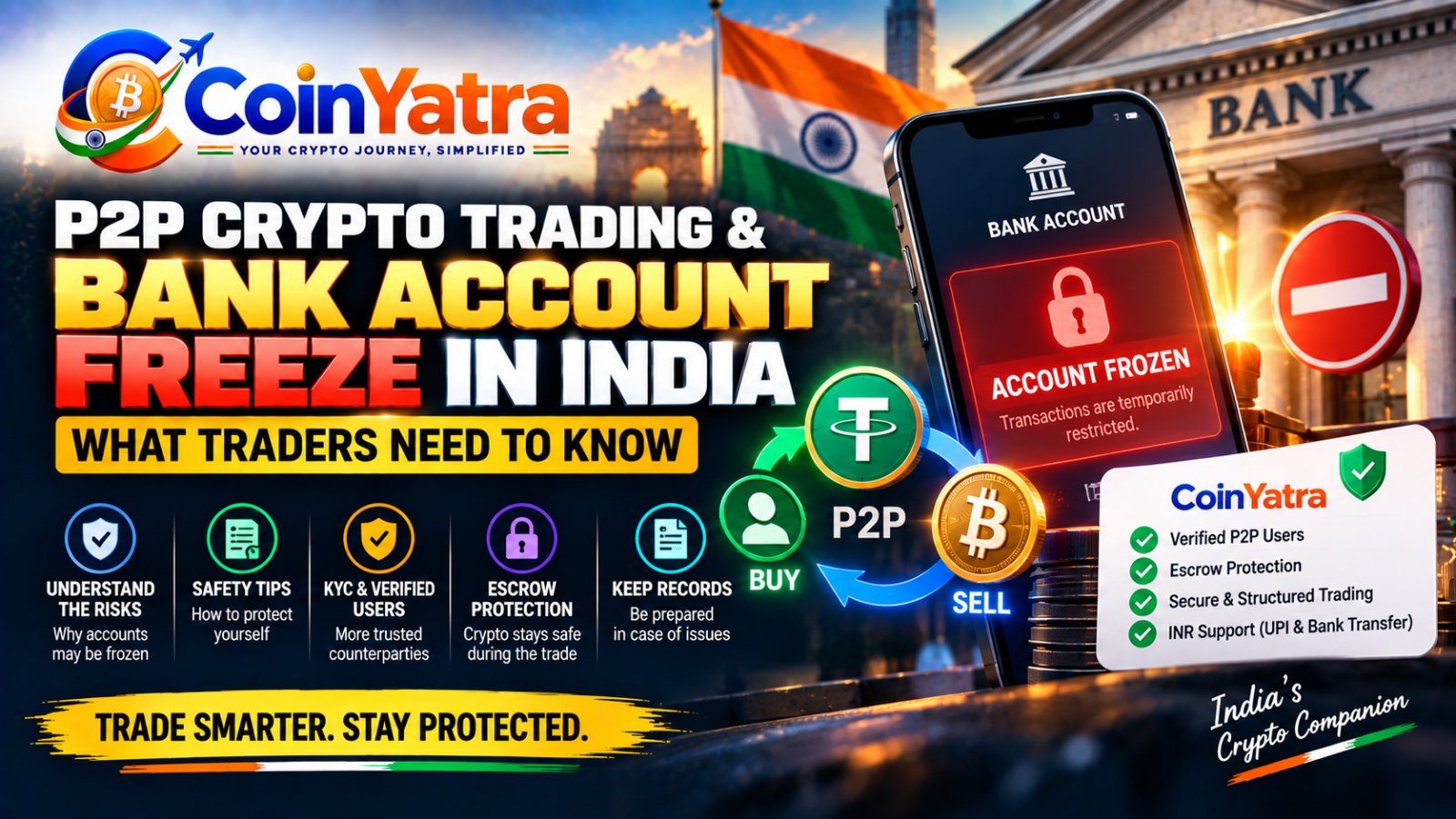
P2P Crypto Trading and Bank Account Freezes in India: What Traders Need to Know
Worried about a P2P crypto bank account freeze in India? Learn why accounts may face restrictions, how to reduce risks and how CoinYatra's escrow and KYC help structure P2P trading.
Published: September 24, 2026
Peer-to-peer (P2P) crypto trading has become a convenient way for Indian users to buy and sell cryptocurrencies such as USDT, Bitcoin and Ethereum using INR. But one issue deserves serious attention: the possibility of a bank account being restricted or placed under a debit hold when incoming funds are later linked to a cybercrime investigation.
This does not mean every P2P trader will face a bank freeze, or that P2P crypto trading itself is illegal. The risk often comes from the source and trail of the INR payment received from another person.
Recent Indian regulatory developments show why users should pay closer attention to transaction records, counterparty information and the origin of funds. In September 2026, the RBI proposed amendments addressing temporary debit holds on amounts or accounts linked to money-mule activity and cyber-enabled financial fraud.
Why Can a P2P Trader's Bank Account Be Frozen?
Imagine you sell ₹50,000 worth of USDT through a P2P transaction.
You receive ₹50,000 in your bank account and release the USDT.
Everything appears normal.
However, suppose the money received by your buyer originally came from a third party who was a victim of an online scam. The transaction may subsequently become part of a cybercrime investigation.
This can create complications for the account that received the money, even if that account holder did not participate in the original fraud.
A recent legal explainer on Indian P2P trading describes cases where legitimate traders can face restrictions after INR received through a P2P transaction is later connected to a cybercrime complaint.
The important distinction is:
A bank account restriction or lien does not automatically establish that the account holder committed a crime.
The circumstances and evidence surrounding the transaction matter.
Why P2P Transactions Can Create This Risk
The fundamental issue is that INR moves directly between two people's bank accounts or UPI accounts.
The crypto platform may hold the cryptocurrency in escrow, but it does not necessarily control the banking transaction itself.
CoinYatra, for example, explains that its P2P escrow holds the crypto, while INR moves directly between the buyer and seller.
That means sellers should pay attention not only to the crypto side of the transaction, but also to the INR payment and the person sending it.
Common risk factors include:
Payments from unrelated third-party accounts
Transactions connected to suspected fraud
Buyers asking you to use another person's bank account
Moving the transaction outside the P2P platform
Accepting unusually attractive offers without checking the details
Poor transaction records
Releasing crypto based only on screenshots or messages
The Indian Cyber Crime Coordination Centre has also warned about the misuse of bank accounts as "mule accounts" for moving illicit funds.
What Is a Mule Account?
A mule account is a bank account used to receive, move or transfer money connected to criminal activity, often on behalf of someone else.
The RBI has been strengthening its approach to detecting and preventing misuse of banking channels for cyber fraud and mule accounts. Government information published in March 2026 said RBI's AI-based MuleHunter.AI system was already live in 26 banks and being expanded.
This is one reason crypto traders should never allow another person to use their bank account for receiving or forwarding money.
RBI's consumer guidance explicitly warns people not to allow others to operate their bank accounts for movement of funds.
How Can P2P Traders Reduce the Risk?
No platform can guarantee that a bank account will never be restricted. However, traders can take practical steps to create a cleaner and better-documented transaction trail.
1. Use a structured P2P marketplace
Avoid random deals arranged through Telegram, WhatsApp or social media.
A structured marketplace can provide an order record, transaction history, counterparty information and an escrow process.
2. Keep everything inside the P2P order
Don't cancel an order simply because someone says:
"I'll pay you directly. It's faster."
Once you leave the platform's order system, you may lose important transaction records and protections.
3. Don't accept third-party payments casually
If the buyer's name and payment details don't match the information associated with the order, stop and investigate before releasing crypto.
CoinYatra's P2P guidance specifically recommends using payment accounts in the user's own verified name and checking payment details before completing a transaction.
4. Verify the actual bank credit
Never release USDT because someone sends you:
A screenshot
An SMS
A WhatsApp message
A payment receipt
A claim that the transfer is "processing"
Open your own banking or UPI application and verify the actual credit.
CoinYatra's P2P process specifically instructs sellers to independently verify that the INR has actually arrived before releasing the crypto.
5. Keep transaction evidence
Save:
P2P order ID
Buyer/seller information
Payment reference/UTR
Bank statement
Transaction date and time
Crypto transaction ID where applicable
Relevant order-chat messages
Screenshots of the completed transaction
The National Cyber Crime Reporting Portal states that bank statements, online money-transfer receipts, emails, URLs, chat transcripts and other documents can be relevant evidence when reporting cybercrime.
Why CoinYatra Can Be a More Structured Option for P2P Trading
For Indian users concerned about P2P transaction safety, CoinYatra provides several features designed to make the trading process more structured and traceable.
🔐 Escrow Protection
When a P2P order opens on CoinYatra, the seller's cryptocurrency is placed into escrow.
The crypto remains locked while the INR payment is being completed.
This reduces the risk of one party receiving the crypto without the corresponding payment process being completed.
👤 KYC and Verified Users
CoinYatra requires verification for P2P trading. Its security documentation explains that KYC supports identity verification and P2P name matching.
That gives traders more information about the counterparty than a completely anonymous deal arranged through social media.
🧾 Transaction Records
P2P orders maintain transaction information such as amounts, timestamps, communication and payment references.
That can be useful if a transaction later needs to be explained or documented.
💬 Dispute Process
If there is a disagreement, CoinYatra's P2P system allows users to raise a dispute while the crypto remains in escrow for review.
🇮🇳 INR-Focused P2P Trading
CoinYatra provides an INR-focused marketplace supporting P2P transactions using payment methods such as UPI and bank transfers.
This makes the transaction flow more structured than arranging a random crypto deal with an unknown person online.
However, escrow and KYC do not guarantee that a bank transaction is free from regulatory or banking risk. INR still moves between the parties' banking accounts, so users should follow proper payment and record-keeping practices.
What If Your Bank Account Is Already Frozen?
If you discover that your bank account has been restricted after a P2P transaction, don't panic and don't delete your transaction history.
Start by collecting your documentation.
Keep:
P2P order details
Buyer/seller information
Bank statement
UTR/payment reference
Crypto transaction hash
Wallet addresses
Platform transaction records
Order-chat history
KYC information
Any communication received from your bank or authorities
The National Cyber Crime Reporting Portal handles reports concerning cryptocurrency crimes and online financial fraud.
It's also important to understand that I4C/NCRP itself does not freeze or unfreeze bank accounts. The official cyber-police portal states that such actions are handled by the relevant law-enforcement agencies.
For a specific freeze or legal notice, getting advice from a qualified Indian lawyer who handles cybercrime/banking matters can be appropriate.
P2P Bank-Freeze Safety Checklist
Before completing a P2P trade, ask yourself:
☑ Am I using a reputable, structured P2P marketplace?
☑ Is the counterparty properly identified/verified?
☑ Does the payment account match the transaction requirements?
☑ Am I receiving the exact amount specified in the order?
☑ Have I checked my actual bank balance?
☑ Am I keeping the complete transaction record?
☑ Am I avoiding third-party payments?
☑ Am I keeping communication inside the platform?
☑ Am I refusing requests to move the transaction off-platform?
☑ Do I have the transaction ID and payment reference saved?
Final Thoughts
P2P crypto trading isn't simply about exchanging USDT for INR. The banking side of the transaction matters just as much as the crypto side.
Indian traders should be particularly careful about the source of incoming payments, third-party transfers, unusually attractive offers and transactions conducted outside established platforms.
CoinYatra's combination of KYC, escrow, structured P2P orders, transaction records and dispute handling is designed to provide a more organized environment for INR-based crypto trading.
But users still have an important responsibility: verify payments, avoid suspicious counterparties, maintain records and never treat escrow as a guarantee against banking or law-enforcement action.
For Indian crypto users, the goal shouldn't simply be finding a buyer or seller. It should be making sure the entire transaction can be clearly documented from beginning to end.