How to Choose a Crypto Exchange in India: 10 Things to Check
Learn how to evaluate a crypto exchange in India by comparing security, KYC, fees, supported assets, INR transactions, liquidity, withdrawals, customer support and account features.
How to Choose a Crypto Exchange in India: 10 Things to Check
Choosing a cryptocurrency exchange is an important decision for anyone buying, selling or trading digital assets in India.
There is no single exchange that is automatically suitable for every user. Different platforms offer different combinations of assets, trading products, fees, INR payment options, security controls and withdrawal policies.
For a beginner, the lowest advertised trading fee may look attractive. But fees are only one part of the picture. An exchange can also differ in its supported cryptocurrencies, INR functionality, liquidity, withdrawal process, customer support and security features.
This guide provides a practical framework you can use to compare crypto exchanges in India based on your own requirements.
Important: This is an educational comparison framework, not a ranking of exchanges or a recommendation to choose any particular platform.
1. Check Security Features
Security should be one of the first things you investigate.
A crypto exchange typically holds or facilitates access to valuable digital assets, so account security and withdrawal controls matter.
Look for features such as:
Two-factor authentication (2FA)
Login and security notifications
Withdrawal authentication
Address validation
Withdrawal reviews
Account activity or security logs
Recovery mechanisms
Secure handling of identity information
Two-factor authentication adds another verification layer beyond your password.
It is also worth checking how an exchange handles withdrawals, because a compromised account can become much more serious if an attacker can immediately move funds out.
For example, CoinYatra currently uses TOTP-based 2FA, recovery codes, security notifications and security-event information, while withdrawals require additional authentication and may undergo review.
The important principle is to examine the actual controls rather than relying only on words such as "secure" or "protected."
2. Understand the KYC Requirements
KYC stands for Know Your Customer.
A crypto exchange may ask you to verify your identity before allowing certain services.
KYC can involve information such as:
Name
Date of birth
Government-issued identification
Address information
PAN or other tax-related information, depending on the platform and applicable requirements
For Indian users, it is also worth understanding the regulatory environment around virtual digital asset service providers.
The Financial Intelligence Unit–India (FIU-IND) states that VDA service providers covered by the relevant framework are required to comply with provisions of the Prevention of Money Laundering Act and related requirements, including customer due diligence, record keeping and suspicious transaction reporting. FIU-IND registration is a prerequisite for reporting entities within that framework.
Therefore, when evaluating an exchange, check:
Does it explain its KYC process clearly?
What services require verification?
How is your information handled?
Can you verify the platform's applicable regulatory registration or status where relevant?
KYC requirements can affect how quickly you can access certain features, so it is better to understand them before depositing funds.
3. Compare the Complete Fee Structure
Don't compare exchanges using only the headline trading fee.
Crypto platforms can have several different charges, including:
Spot trading fees
P2P fees
Withdrawal fees
Swap fees
Network-related costs
Spreads
Other product-specific charges
For example, a platform may advertise a low trading fee but have a different withdrawal cost or spread.
A useful approach is to calculate the total cost of the transaction you actually expect to make.
If you regularly:
INR → USDT → BTC
you should examine the costs involved at each stage rather than looking at only the BTC trading fee.
CoinYatra publishes separate fee information for spot trading, P2P, swaps and withdrawals, illustrating why users should review the complete fee schedule rather than one headline percentage.
Fees can change, so always check the current fee page before completing a transaction.
4. Check Which Cryptocurrencies Are Supported
Not every exchange supports the same digital assets.
Some users may only need Bitcoin and Ethereum.
Others may want access to assets such as:
Bitcoin
Ethereum
Solana
XRP
USDT
Litecoin
Cardano
Chainlink
Dogecoin
Other supported assets
But the number of listed assets isn't necessarily the only thing to examine.
You should also check:
Which assets can you buy with INR?
Which assets have spot markets?
Which assets can you deposit and withdraw?
Which networks are supported?
An exchange may list an asset but not provide every function for that asset.
For example, CoinYatra currently lists assets including BTC, ETH, USDT, SOL, XRP, TRX, DOGE, UNI, LTC, XLM, DOT, ADA, BCH, LINK and NEAR, while the exact trading, deposit and withdrawal options vary by asset.
So instead of asking only "How many coins does the exchange have?", ask "Can I actually use the assets I need in the way I need?"
5. Check INR Support
For users in India, INR functionality can make a major difference.
If your goal is to buy or sell cryptocurrency using Indian rupees, investigate how the exchange handles:
INR deposits
INR withdrawals
P2P transactions
UPI payments
Bank transfers
INR pricing
Settlement times
Payment verification
Some platforms may focus primarily on crypto-to-crypto trading, while others provide an INR marketplace.
CoinYatra describes its platform as INR-first, with an INR P2P marketplace and UPI or bank payment methods.
The important thing is to match the platform's INR functionality with your actual requirements.
If you frequently move between INR and crypto, this can be more relevant than simply comparing the number of available cryptocurrencies.
6. Look at Trading Liquidity
Liquidity refers to the amount of buying and selling activity available in a market.
It matters because an exchange may display a particular price, but there may not be enough orders at that exact price for a larger transaction.
In a spot market, check:
Order-book depth
Bid and ask prices
Trading volume
Recent trades
Spread between bids and asks
For example, imagine BTC is displayed at ₹70 lakh, but only a small amount of BTC is available near that price.
A larger market order could execute across multiple price levels.
This is one reason liquidity and trading fees should be considered together.
A lower fee does not automatically mean a lower total transaction cost if the market has limited liquidity or a wider spread.
7. Understand Deposits and Withdrawals
Depositing crypto and withdrawing crypto involve more than simply entering an amount.
You should understand:
Supported networks
Minimum deposits
Minimum withdrawals
Withdrawal fees
Processing procedures
Confirmation requirements
Address verification
Memo or tag requirements where applicable
This becomes particularly important when an asset exists on multiple networks.
For example, USDT can exist on different networks, and sending the wrong network can result in funds not arriving as expected.
CoinYatra currently supports USDT on BNB Smart Chain and Ethereum's ERC-20 network, with network-specific withdrawal requirements and fees.
Before withdrawing, always confirm:
Asset + Network + Address
All three need to match the receiving platform or wallet.
Also check the final amount you will receive after any applicable withdrawal fee.
8. Examine the Trading Products
Different users need different trading tools.
An exchange may provide:
P2P trading
Spot trading
Instant swaps
Limit orders
Market orders
Advanced trading interfaces
Derivatives or futures
A beginner may only need simple spot trading.
Another user may specifically need an order book and limit orders.
For example, CoinYatra currently provides INR P2P trading, spot markets and instant swaps as separate ways of interacting with supported digital assets.
Before opening an account, ask:
What exactly do I want to do with crypto?
If you want to buy BTC with INR, your requirements may be different from someone who wants to actively trade BTC/USDT.
9. Check Customer Support
Customer support is easy to ignore when everything works normally.
It becomes much more important when:
A deposit hasn't appeared
A withdrawal is being reviewed
You sent crypto to an incorrect network
A P2P transaction has a dispute
Your account has a security issue
You need clarification about a transaction
Look for:
A clearly identified support channel
Help documentation
Ticket-based support
P2P dispute procedures where applicable
Transaction-specific support
Clear warnings about impersonators
Be particularly careful with unofficial Telegram, WhatsApp or social-media accounts claiming to be exchange support.
CoinYatra's security guidance, for example, advises users to use official support channels and never share passwords, 2FA codes or recovery information with someone claiming to be support.
A useful question is:
"If something goes wrong with my transaction, how do I actually contact the platform?"
Find the answer before you need it.
10. Check Transaction History and Records
Good record keeping is useful for both personal tracking and tax-related purposes.
Look for access to:
Deposit history
Withdrawal history
Trading history
Order history
Transaction statements
Fees
Transaction IDs
Downloadable records, where available
This becomes particularly important if you make many transactions.
India has specific tax provisions relating to virtual digital assets. The Income Tax Department provides mechanisms for reporting VDA transactions, including a dedicated VDA schedule in applicable income-tax returns.
Tax rules can change, and your individual tax position may depend on your circumstances, so exchange records should not be treated as a substitute for professional tax advice.
The practical lesson is simple:
Keep your transaction records.
Bonus: Check the Platform's Transparency
Beyond the 10 main factors, take a few minutes to examine how transparent the exchange is.
Look for clearly accessible information about:
Fees
Limits
Supported assets
Networks
KYC
Withdrawal procedures
Risk disclosures
Terms and conditions
Contact information
Privacy practices
A platform that clearly explains how its products work gives users more information to make their own comparison.
Don't judge an exchange only by its homepage.
Read the fees page, withdrawal information, terms and security documentation as well.
How to Compare Two Crypto Exchanges
You don't need a complicated spreadsheet to compare platforms.
Start by writing down what you actually need.
For example:
My requirements
Buy crypto using INR
Sell crypto for INR
Trade BTC and ETH
Hold USDT
Withdraw crypto
Use UPI
Use limit orders
Access transaction records
Have 2FA
Then check each exchange against those requirements.
This creates a much more useful comparison than simply searching for a "best crypto exchange."
One person's priorities may be low trading costs.
Another person's priorities may be INR access and easy withdrawals.
Another user may care more about supported assets or advanced trading tools.
Your own usage pattern should determine which factors matter most.
A Simple Crypto Exchange Checklist
Before depositing money, check:
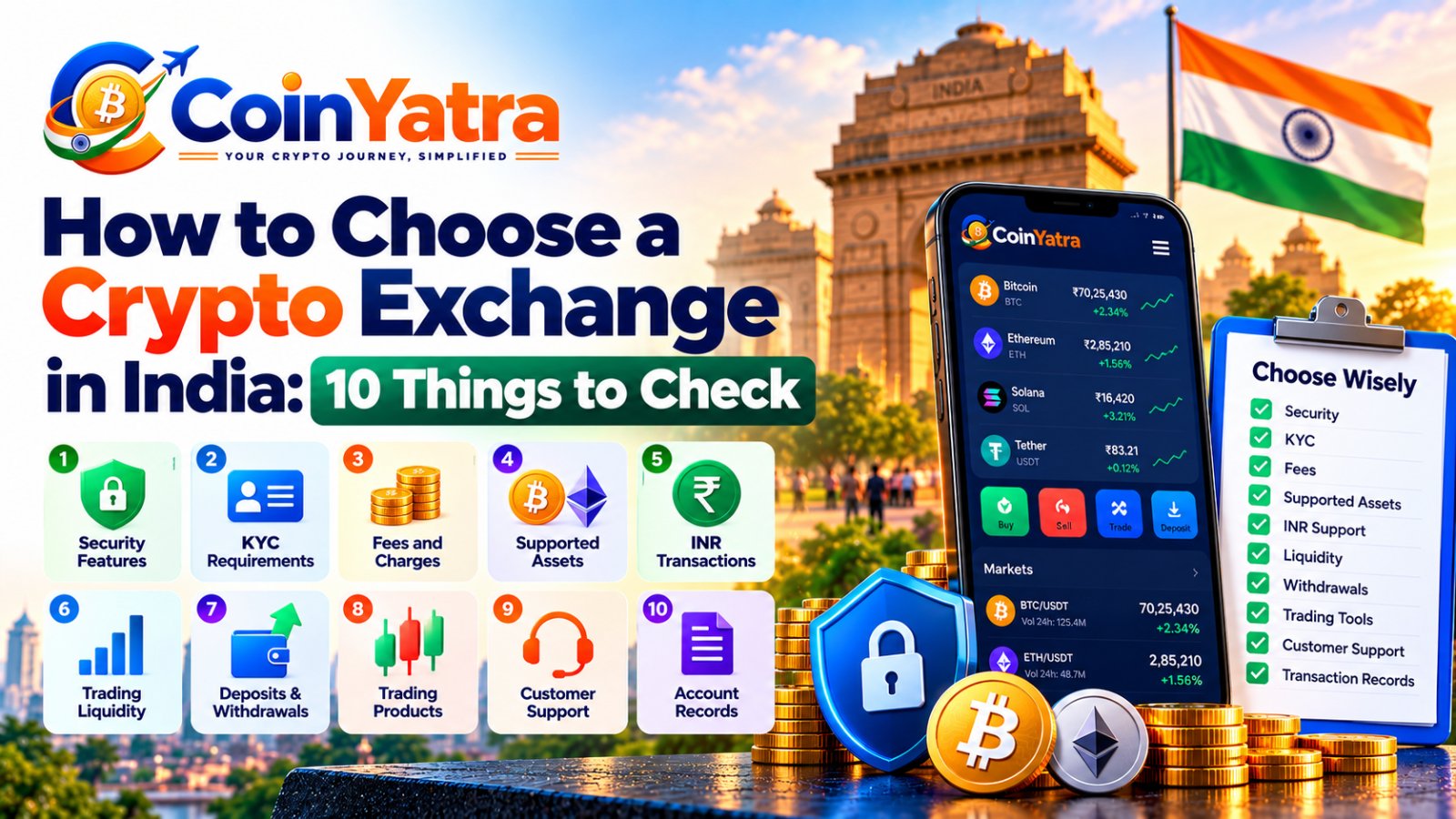
Security — Does the platform provide meaningful account and withdrawal controls?
KYC — What verification is required?
Fees — What will the complete transaction cost?
Supported assets — Does it support the cryptocurrencies you need?
INR support — Can you conveniently move between INR and crypto?
Liquidity — Is there sufficient market activity for your intended trades?
Withdrawals — Are fees, networks, limits and procedures clearly explained?
Trading tools — Does the platform provide the order types and products you need?
Customer support — Can you get help through official channels?
Records — Can you access useful transaction and trading history?
If you can answer all ten questions, you have a much clearer basis for comparing exchanges.
Where CoinYatra Fits Into This Framework
CoinYatra is one example of an India-focused crypto platform that can be evaluated using the same framework.
Its current platform combines INR P2P trading, spot trading, instant swaps, crypto deposits and withdrawals, along with account-security features such as KYC, 2FA and reviewed withdrawals.
CoinYatra also publishes information about fees, supported assets and withdrawal requirements, allowing users to review those details before using the relevant services.
However, these features should be considered alongside the user's own requirements. An educational comparison should focus on what a platform offers and how those features work, rather than declaring one exchange universally better than another.
You can review CoinYatra's available services, fees and requirements and compare them with other exchanges based on the factors discussed in this guide.
Final Thoughts
Choosing a crypto exchange in India doesn't have to mean finding a platform with the biggest advertising campaign or the lowest headline fee.
A more useful approach is to examine the complete user experience.
Start with security and KYC.
Then look at fees, supported assets and INR functionality.
After that, examine liquidity, deposits, withdrawals, trading tools and customer support.
Finally, make sure you can access the records you need for your own tracking and tax reporting.
The right comparison depends on what you intend to do with cryptocurrency.
Instead of asking:
"Which crypto exchange is the best?"
ask:
"Which platform's features, costs, security controls and services match my requirements?"
That question gives you a much more practical way to evaluate your options.
Cryptocurrency prices are volatile and digital assets can lose value. This article is for educational purposes only and is not financial, investment, legal or tax advice. Users should independently review an exchange's current terms, fees, regulatory status and applicable requirements before using it.